While boisterous anti-war street protests at the UN General Assembly dominated headlines in September, fears about the growth of artificial intelligence commandeered the agenda at many of the events attended by business leaders.
From Climate Week summits to roundtable gatherings of sustainability and corporate responsibility professionals, AI was singled out as a top risk for business.
“Energy guzzling artificial intelligence is driving up planet-heating pollution from coal, oil and gas, while ratcheting up energy costs for households and businesses. All while fuelling disinformation, social division, and even larger inequalities of wealth,” said UN Climate Change Executive Secretary Simon Stiell at the Build Clean Now Industry Acceleration Summit. “AI leaders are now on thin ice when it comes to license to operate, and sinking deep underwater when it comes to public support.”
Several hyperscalers, including Google, organized their own summits to highlight projects to power data centers with carbon-free energy, and committed to using satellite data to map global methane leaks. The Fusion Industry Association and many electric grid infrastructure technology companies also used Climate Week to hawk their wares.
Perhaps one of the least self-serving examples of a business-centric discussion of AI was organized by Mastercard’s Center for Inclusive Growth.
“We know that, as much as there is potential for good, there is potential for bad. So we are not blind to that,” Shamina Singh, founder and president of the center, told several hundred attendees during a New York City event. “It’s important that we have to battle the forces for bad as much as we lift up the forces for good.”
Large-scale corporate layoffs attributed to AI are not occurring in the United States, but AI’s impact on hiring recent college graduates has been profound, Martin Whittaker, CEO of the nonprofit research organization Just Capital, told attendees at the Mastercard forum.
Fifty-two percent of corporate leaders say they expect fewer entry level positions to be available for the next two to three years,” said Whittaker, adding that both recent college graduates and those currently in the workforce feel their AI skills are inadequate.
“You could say AI is the economy,” Whittaker said, referencing an estimate in the Wall Street Journal that AI’s impact on the U.S. economy will be $10 trillion, with up to $4.8 trillion focused on the top five hyperscalers. “To the extent that the story of America is the story of human risk, human endeavor, that’s going to be tested, tested to the full. Understanding the human impacts is going to be more and more important.”
Retraining the U.S. workforce so it has the skills to thrive in an economy driven by AI is the focus of a newly formed nonpartisan, nonprofit organization, RAISE US, which briefed the Mastercard gathering about its first three months of operation.
Founded by two former governors – Democrat Gina Raimondo of Rhode Island and Republican Eric Holcomb of Indiana – the group is backed by two dozen founding partners: ADP, AMD, Autodesk, Blackstone, Boston Consulting Group, Cisco, Coefficient Giving, Cognizant, Deloitte, Eli Lilly and Company, The Ford Foundation, General Motors, Goodman Philanthropies, Greg Mondre, IBM, Infosys, Mastercard, Pritzker Traubert Foundation, Rockwell Automation, ServiceNow, Siegel Family Endowment, Tandem Philanthropies, UPS, Walton Family Foundation, The Wilke Family Foundation and Workday.
Among the workforce development goals for “fixing the leaky talent pipeline” are creating programs in local communities to “meet people where they are,” including both incumbent and laid-off workers, those who are incarcerated, and entry-level personnel, said Holcolmb.
“I was just with the CEO of a fairly significantly large company, who was talking to me about the anxiety when they started introducing the computer into the workforce. People thought … the machine is going to replace me,” Holcomb said.
RAISE US will work with states, employers and educators on “earn-and-learn programs” including co-ops, apprenticeships, internships and externships to provide skills for the “AI-infused economy,” including quantum computing and robotics.
“The jobs will change. Tasks will change,” Holcomb said. “Whether it’s urban, rural, suburban, all of the above, what we’ve got to be thinking about is, Are we providing the tools in the community centers, in the libraries?”


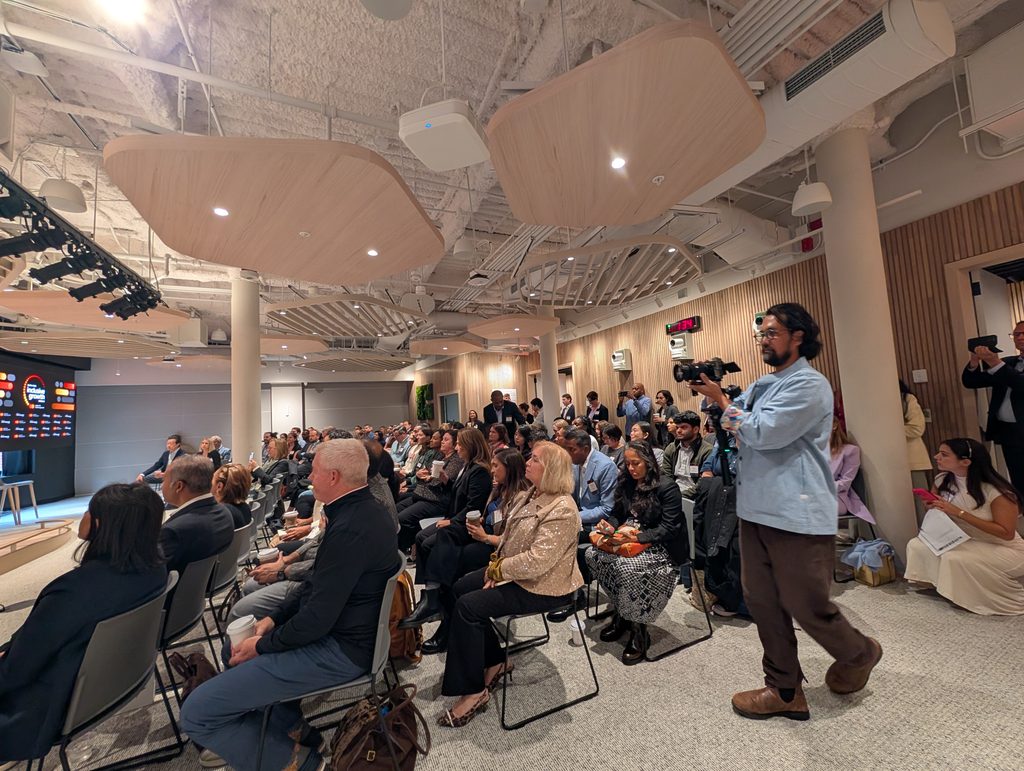


All photos are by Dave Armon