Company Newsroom: A Redesigned Media Hub for Storytelling
The 3BL Company Newsroom has a whole new look. Designed to put your story first, the new experience opens with a full-width hero banner, your logo, and a clear tagline, so visitors know exactly who they’re looking at the moment the page loads.
Your latest news gets a featured spot with a large image, and everything else follows in a clean, scannable feed. Tabs sort your content into releases, campaigns, and videos, and each story carries its own thumbnail and category label. Instead of reading down a list, visitors can see the full range of what you publish at a glance.
A sidebar keeps the essentials close: a newsletter signup, a resources section, and a media contact card with a photo, title, and email. The page is easy to share, too. Every image, label, and layout choice is there to cut the time it takes someone to understand a company and trust what they find.
Behind the design is a simple idea: your newsroom is a media hub, a dedicated space to showcase every storytelling medium you use, from press releases to campaigns to video. It’s built for 3BL’s audience of investors, journalists, and regulatory and policy makers, people who need the full picture of a company quickly and can now find it in one place.
The new Company Newsroom is live now. Browse the newsroom to see it for yourself.
Until now, each story in our newsletters listed only the company name and headline. Starting this week, every story includes more context:
Featured images are back. Each story now appears with its featured image, so readers can spot the news they want at a glance.
Categories. Each story is labeled with its topic, such as AI & Technology, Philanthropy, or Inclusion & Opportunity, so readers can quickly find coverage in the areas they follow.
Publishing dates. Each story shows the date it was published, next to the company that shared it.
Together, these changes make each issue easier to scan, and gives readers a better sense of a story before they click and companies’ news more room to stand out in the inbox.
For organizations distributing news with 3BL, this means your featured image matters more than ever. A strong, relevant image that clearly represents your story helps it get noticed among the day’s headlines. No featured image for your story? No worries, it will default to your logo instead.
How leaders defined trust at the recent PR Week Conference in Chicago and what organizations can learn from it.
Dave ArmonVice Chairman
Being in a room of accomplished communications leaders is one of the perks of my role at 3BL, and the recent PR Week Conference in Chicago did not disappoint. Here are some takeaways under the theme of trust.
Valerie Jarrett, CEO of the Obama Foundation, speaks at the PR Week Conference in Chicago last week.
Valerie Jarrett, CEO of the Obama Foundation, gets real about the challenges of building trust in communities
The sledding hill at the 19.3-acre Obama Presidential Center was built at the request of former First Lady Michelle Obama, who grew up lacking a snowy incline on the South Side of Chicago, said Valerie Jarrett, CEO of the Obama Foundation.
The center has been open since June and features a new branch of the Chicago Public Library, an athletic center, playground and other features requested by the community during a listening tour that included 1,000 meetings, Jarrett said. Opponents of the project objected to the use of a city park, among other issues.
Earning trust starts with listening, said Jarrett, an attorney who served as a senior advisor to President Barack Obama from 2009 to 2017. “You do have to learn how to take a punch without it debilitating you or making you numb, and it’s a delicate balancing act.”
Richard Edelman interviewed by PR Week’s Jessica Ruderman.
Richard Edelman, CEO of the Edelman communications firm, reflects on two decades of the Trust Barometer
Richard Edelman reflected on his namesake firm’s 75-year history in Chicago, crediting his father Daniel for inventing the media tour. With big shoes to fill when the baton was passed, Richard borrowed a page out of the playbook used by large consulting firms: intellectual property. “I saw McKinsey, Booz Allen and BCG having IP,” he said, adding, “I came up with trust.” The Edelman Trust Barometer debuted in 2000.
Headline Trust Barometer findings in recent years centered on polarization, grievance and insularity. The upcoming edition will focus on agency. “I think people feel very out of control. They think they’re going to lose their jobs to AI. I think they’re afraid of downward economic mobility. I think they’re afraid that they don’t get good information,” Edelman said. “If you give people agency through reskilling or through information from reliable sources, I think you’re in a different world.”
Lindsay Kurtz, McDonald’s director of brand communications, tracks trust and reputation regularly
There’s more than burgers and fries cooking under McDonald’s golden arches. The U.S. communications team closely watches a “global reputational impact tracker,” measuring 120 perception statements on topics like food quality and crew well-being, said Lindsay Kurtz, director of brand communications. Reports are provided quarterly, and pulse surveys can be conducted in real-time when necessary.
Storytelling is a primary tactic to boost trust in McDonald’s, said Kurtz, adding that these ongoing narratives are proven to minimize damage when problems arise.
“The analogy that I use is kind of like a bank – we call it our trust bank,” Kurtz said. “If you think about daily deposits of trust into a bank account, if there’s a withdrawal or a crisis occurs, if you have a healthy balance of trust with your customers, they will give you the benefit of the doubt.”
Communications is embedded into cross-functional teams that include government relations, supply chain and new product launches to provide counsel and look for stories that can bolster trust, Kurtz said.
Talk to our team to learn more about driving brand trust
Is ChatGPT Your Biggest Cheerleader or Harshest Critic? A Better Way to Find Out
3BL’s AI Visibility Tracker introduces a new methodology and prompt library to help brands understand how AI platforms shape their reputation.
Most AI visibility tools focus on mention volume (whether a brand shows up in AI responses and how often). While that’s useful for understanding awareness, it doesn’t answer the bigger question: How is your brand actually being perceived? When stakeholders ask AI platforms like ChatGPT and Claude about your organization or your industry, what do those platforms say in response, and how do those responses represent you?
As more people turn to AI platforms over traditional search to research brands and make decisions, the gap between brand visibility and brand representation is becoming more consequential every day. With more than 50% of consumers intentionally choosing AI over traditional search, knowing whether your brand shows up is one thing, but understanding what people are learning about your brand is another.
What Sets 3BL’s AI Visibility Tracker Apart
3BL created the AI Visibility Tracker to go beyond the “is my brand being mentioned?” question. It shows you what AI responses are actually saying about your brand, and the sentiment behind those responses, to assess how AI responses could help or harm your reputation.
A stronger framework for measuring reputation
The AI Visibility Tracker launched in beta earlier this year, gathering valuable feedback from testers over the past six months. Now, 3BL is building on those insights to advance how we measure AI’s influence on brand reputation.
We have updated our methodology and our prompt library, now built around seven broad criteria widely used in academia and industry to measure corporate reputation. These criteria extend to 29 thematic subtopics, grounded in 3BL’s 100 Best Corporate Citizens methodology and academic research, that reflect the questions people ask that shape how they feel about a brand.
The seven reputational pillars:
Products & Service → The core business: how reliable and secure the company’s products and services are, how customers experience the company, and whether customers feel they get a fair deal for what they pay.
Innovation → The future: whether the company leads or follows industry peers, how it responds to market shifts, and how it integrates AI and other emerging technologies.
Workplace → The people: how a company treats employees, whether it’s known as a good place to work, and the ways it helps top talent advance their careers.
Conduct & Governance → The standards: how openly the company reports about its operations, how it treats suppliers and rivals, how it ensures ethical conduct, and how it responds to crisis.
Citizenship & Impact → The footprint: how the company impacts communities and the environment, including resource use, greenhouse gas emissions, community investment and philanthropy, and supplier human rights.
Leadership → The vision: whether the company has a clear long-term direction, the quality of management, and the credibility of the leadership team and CEO.
Financial Performance → The books: how financially strong a company is, whether it makes money, and whether it delivers the results the market expects.
This is the first in a series of updates to the AI Visibility Tracker. As AI becomes the first place many people go to learn about a company, what matters is what is being said, and whether these responses are building or eroding trust. Our goal is to give brands the ability to see those connections more clearly and act on them.
Curious how AI platforms are portraying your brand?
Our daily newsletters, CSRWire Daily and 3BL Daily, have a new look. We refreshed their banners and added sign-up forms across our site. Both changes serve one goal: putting the stories our customers publish in front of more readers.
A sharper first impression
The banner is the first thing a subscriber sees when they open the email, so we rebuilt both from the ground up.
CSRWire Daily now opens with a bold black-and-white architectural image and the line “Corporate-responsibility news, trusted since 1999.” It’s a confident, modern look that honors more than 25 years of reporting on corporate responsibility.
3BL Daily pairs a clean serif wordmark with a collage of recent customer stories, under the tagline “The latest news from leading brands.” Customer content is front and center before a reader even reaches the first headline.
More ways to subscribe
A great newsletter only works if people find it. We’ve placed sign-up forms at strategic points across our site, right where readers are already engaging with content. Subscribing now takes a single step from the stories they’re reading.
What it means for our customers
Every new subscriber is another reader for the brands that share their news with us. More subscribers mean more inboxes, more opens and more eyes on customer stories every day.
Every day, brands share news about their sustainability and corporate responsibility work through 3BL. Our redesigned site makes that news easier to find, follow, and act on.
Takeaways
Key pages like home, newsroom, categories and newsletter all received visual updates
Newsletters sign up forms are now accessible from multiple pages
Home. The refreshed navigation sets the tone: mixed-case type, a clear split between primary links and utility actions like Log in, and a single blue accent that guides the eye. Clear sections for featured content, trending content, Report Alerts, and campaigns all have clear distinction with continuous flow so visitors can see the breadth of your publications.
Newsroom. We cleaned up the layout and made the filters easier to use. You can narrow the feed by company, category, media type, or industry and get to the right story faster.
Category. Topic pages like Environment and AI & Technology give each subject an easy-to-scan home so readers interested in a topic can dive right in.
Newsletter. Signup is simpler so readers can pick the publications they want and subscribe with one clear button.
A site that’s easy to navigate keeps readers browsing, and the longer they browse, the more stories they see. For the brands we work with, that means releases, multimedia, and campaigns presented consistently and professionally, with a better chance of being noticed.
Reskilling U.S. workforce for AI-infused economy is Climate Week focus
Dave ArmonVice Chairman
While boisterous anti-war street protests at the UN General Assembly dominated headlines in September, fears about the growth of artificial intelligence commandeered the agenda at many of the events attended by business leaders.
From Climate Week summits to roundtable gatherings of sustainability and corporate responsibility professionals, AI was singled out as a top risk for business.
“Energy guzzling artificial intelligence is driving up planet-heating pollution from coal, oil and gas, while ratcheting up energy costs for households and businesses. All while fuelling disinformation, social division, and even larger inequalities of wealth,” said UN Climate Change Executive Secretary Simon Stiell at the Build Clean Now Industry Acceleration Summit. “AI leaders are now on thin ice when it comes to license to operate, and sinking deep underwater when it comes to public support.”
Several hyperscalers, including Google, organized their own summits to highlight projects to power data centers with carbon-free energy, and committed to using satellite data to map global methane leaks. The Fusion Industry Association and many electric grid infrastructure technology companies also used Climate Week to hawk their wares.
Perhaps one of the least self-serving examples of a business-centric discussion of AI was organized by Mastercard’s Center for Inclusive Growth.
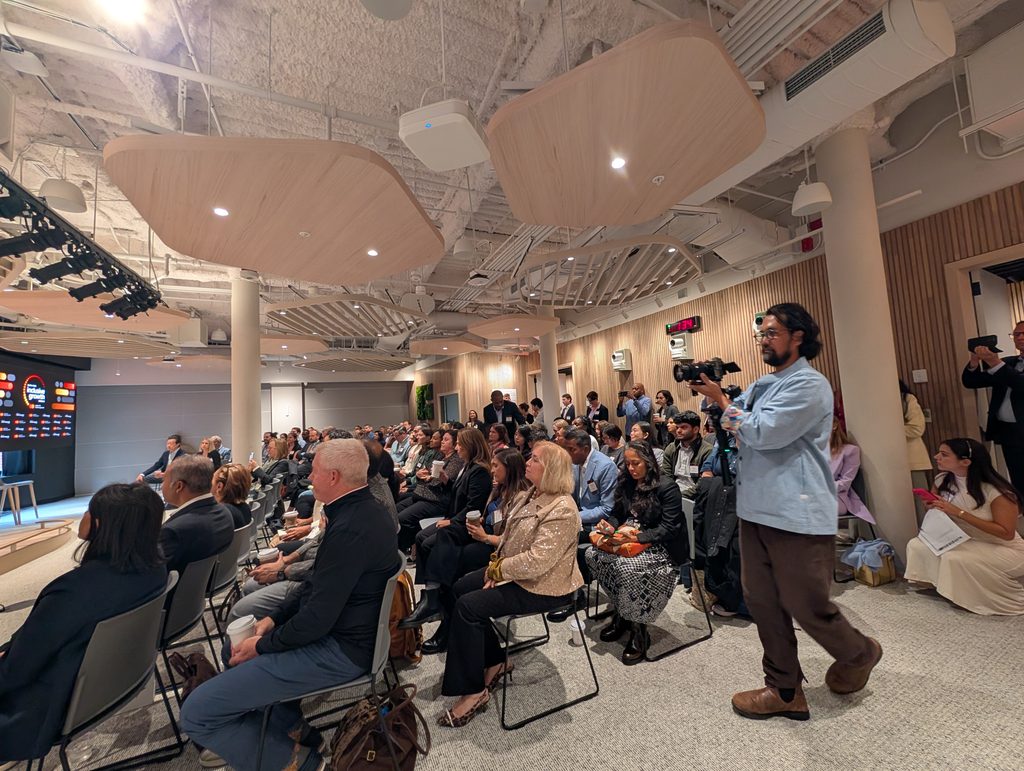
“We know that, as much as there is potential for good, there is potential for bad. So we are not blind to that,” Shamina Singh, founder and president of the center, told several hundred attendees during a New York City event. “It’s important that we have to battle the forces for bad as much as we lift up the forces for good.”
Large-scale corporate layoffs attributed to AI are not occurring in the United States, but AI’s impact on hiring recent college graduates has been profound, Martin Whittaker, CEO of the nonprofit research organization Just Capital, told attendees at the Mastercard forum.
Fifty-two percent of corporate leaders say they expect fewer entry level positions to be available for the next two to three years,” said Whittaker, adding that both recent college graduates and those currently in the workforce feel their AI skills are inadequate.
“You could say AI is the economy,” Whittaker said, referencing an estimate in the Wall Street Journal that AI’s impact on the U.S. economy will be $10 trillion, with up to $4.8 trillion focused on the top five hyperscalers. “To the extent that the story of America is the story of human risk, human endeavor, that’s going to be tested, tested to the full. Understanding the human impacts is going to be more and more important.”
Retraining the U.S. workforce so it has the skills to thrive in an economy driven by AI is the focus of a newly formed nonpartisan, nonprofit organization, RAISE US, which briefed the Mastercard gathering about its first three months of operation.
Founded by two former governors – Democrat Gina Raimondo of Rhode Island and Republican Eric Holcomb of Indiana – the group is backed by two dozen founding partners: ADP, AMD, Autodesk, Blackstone, Boston Consulting Group, Cisco, Coefficient Giving, Cognizant, Deloitte, Eli Lilly and Company, The Ford Foundation, General Motors, Goodman Philanthropies, Greg Mondre, IBM, Infosys, Mastercard, Pritzker Traubert Foundation, Rockwell Automation, ServiceNow, Siegel Family Endowment, Tandem Philanthropies, UPS, Walton Family Foundation, The Wilke Family Foundation and Workday.
Among the workforce development goals for “fixing the leaky talent pipeline” are creating programs in local communities to “meet people where they are,” including both incumbent and laid-off workers, those who are incarcerated, and entry-level personnel, said Holcolmb.
“I was just with the CEO of a fairly significantly large company, who was talking to me about the anxiety when they started introducing the computer into the workforce. People thought … the machine is going to replace me,” Holcomb said.
RAISE US will work with states, employers and educators on “earn-and-learn programs” including co-ops, apprenticeships, internships and externships to provide skills for the “AI-infused economy,” including quantum computing and robotics.
“The jobs will change. Tasks will change,” Holcomb said. “Whether it’s urban, rural, suburban, all of the above, what we’ve got to be thinking about is, Are we providing the tools in the community centers, in the libraries?”
Moments Ahead is the AI-powered publishing insights tool that uses real-time industry signals to surface topics, trends, and events most relevant to your organization and turns them into real publishing opportunities.
Moments is more than a generic calendar
The hardest part of publishing isn’t the distribution. It’s deciding what to say and when. Most communications and sustainability teams rely on editorial calendars filled with hundreds of awareness dates, but those calendars can only tell you what’s coming, not what actually matters.
Start with what’s currently shaping the conversation
With Moments, you can see:
Industry, policy, and cultural shifts
Sustainability and workforce observances relevant to your sector
Conferences and events
Competitor announcements, campaigns, and reports
Regulatory deadlines and reporting cycles
Every Moment comes with context, not just a date
Instead of starting from scratch, teams can move from spotting a moment to making an informed communications decision in minutes.
Competitor activity: Shows you how actively companies in your industry are responding to or publishing around this Moment.
Confidence: Helps you quickly understand the relevance and meaningful opportunity for your organization.
Attention Level: Shows how much attention a Moment is receiving based on signals across your industry and audience.
Why it matters: This is where the real-time context comes in. Instead of spending time researching, we tell you exactly how each Moment connects to industry trends, competitor activity, audience interest, or broader market trends.
Potential opportunity: This is where we bridge the gap between “this is happening” and “here’s what you can do about it.” It gives your team a starting point for turning a relevant moment into a story, perspective, campaign, or other piece of content.
Check where the attention is going
Understand what’s gaining attention, where interest is growing, and where opportunities may exist.
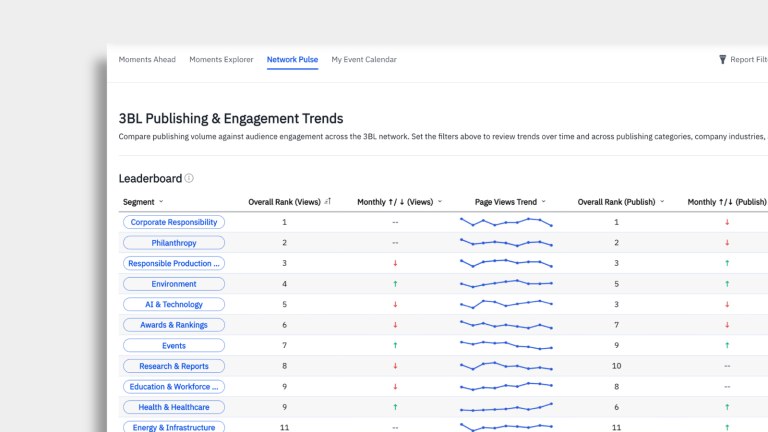
Publishing vs Engagement
See what segments are shifting in momentum. Ranked by audience engagement and publishing activity, with monthly trends so you can spot where interest is growing, where conversations are cooling, and where there is opportunity to lean in.
See what’s working in your space
Explore the strongest performing stories in each segment to spot patterns, spark ideas, or explore opportunities for your own content.
Put Moments and your corporate calendar side by side
Add your corporate calendar and publishing schedule to your Moments view. Your plans and the moments worth planning around live in one place.