asdas
Industry Insights
NOVEMBER 18, 2025

The ‘Health Halo Effect’ Shows How Industries Discovered the Same Story


 A Minnesota refinery published a story about worker well-being. An energy company in Georgia announced a utility assistance program. A logistics company responded to a hurricane. On the surface, these stories have nothing in common: different industries, different initiatives, different goals. But these three companies all discovered the same truth: No matter what impact you’re trying to create, you’re ultimately affecting human health, and that’s a story stakeholders care about. Look closer at how they told these stories, and a pattern emerges. The refinery didn’t just talk about safety compliance; it framed the story around employee health outcomes. The energy company didn’t position its program as rate assistance; it explicitly called it a health equity intervention. The logistics company didn’t just ship supplies; it delivered medical aid and mental health support.

Health Emerges as a Universal Language for Communicating Corporate Value

When we analyzed the close to 400 featured news releases published across the 3BL network in October 2025, we found the highest month-over-month growth in Health & Healthcare content. That’s no surprise — after all, October does bring Breast Cancer Awareness Month, World Mental Health Day, and the start of benefits enrollment season. What we didn’t expect was for the numbers to tell two completely different stories. The official count: About 12% of October’s content was categorized as “Health & Healthcare.”  The actual count: When we read through the stories, we found that nearly 37% of all content published through our network contained significant health angles. Meaning: Health-related content was three times more prevalent than its categorization suggested. So what? This is a signal that health continues to evolve from a sector-specific topic into something much bigger: a universal language for communicating corporate value.

Health Comms Reach a Tipping Point in October

Last month’s publishing is an ideal test case to see how organizations are talking about health, and how health implications and impacts are showing up in communications across topics. Here are three forces that converged: The calendar aligned perfectly. Breast Cancer Awareness Month coincided with World Mental Health Day (October 10) and Mental Health Awareness Week. Aflac transformed its headquarters with a giant checkered pattern to remind employees to “check for cancer.” The Mary Kay Ash Foundation announced $3 million in cancer research grants. MetLife’s global BeWell initiative connects employees to health and wellness resources, and others have launched preventive care campaigns. Nature didn’t cooperate with anyone’s timeline. Hurricane Melissa devastated the Caribbean, Hurricane Helene hit North Carolina and a typhoon struck Alaska, each disaster generating health-focused stories about how organizations were responding. Direct Relief alone appeared in multiple releases this month, partnering with other organizations in 3BL’s network to provide medical supplies, emergency funds, and support for healthcare infrastructure. ESG reporting has evolved. With health metrics increasingly expected in sustainability reports and investors asking pointed questions about employee well-being and community health impact, companies can no longer afford vague commitments and need concrete health outcomes to report.

Health Refuses to Stay in One Lane

When SCS Global Services launched its International Lead Poisoning Prevention Week campaign, was that environmental remediation or child health protection? Both. When energy companies in Gwinnett County, Georgia, implemented programs to reduce energy burdens, was that utility policy or health equity? Both. When Marathon Petroleum hosted a safety fair at its St. Paul Park refinery, was that governance compliance or occupational health improvement? Both. The distinction increasingly doesn’t matter — and that’s precisely the point. Consider how stakeholders actually process these stories. An investor reading about “reducing lead exposure in water systems” might intellectually understand the environmental benefit. But when the same initiative is framed as “protecting children from developmental health impacts,” the human consequence becomes immediately, viscerally clear. GP PRO’s hand hygiene survey illustrates this shift. Rather than framing the story around product innovation or research, they led with infection prevention and control, a concrete health outcome that resonates with healthcare professionals, facility managers, and consumers alike.  The organizations aren’t choosing between environmental and health framing; they’re using health as the translation layer that makes ecological and social impact immediately tangible.

Mental Health Crossed the Executive Threshold

The most significant October milestone wasn’t a product launch or a research study. It was something more subtle: where mental health conversations happened and who was having them.

The Pattern Beneath the Pattern

October publishing on our network reveals a pattern that most companies were unconsciously following. Companies didn’t necessarily decide to “do health messaging.” They were naturally gravitating toward the language that best conveyed their impact on employees and communities. While October 2025 is just a snapshot, the forces driving health-focused communication — from post-pandemic awareness to ESG pressure and stakeholder expectations — aren’t going away. Telling stories through the lens of health shows our audiences the true purpose behind these frameworks: whether our organizations are making human lives better.

Stay up to date on the latest impact stories from leading brands across our network, here.

Talk to our team

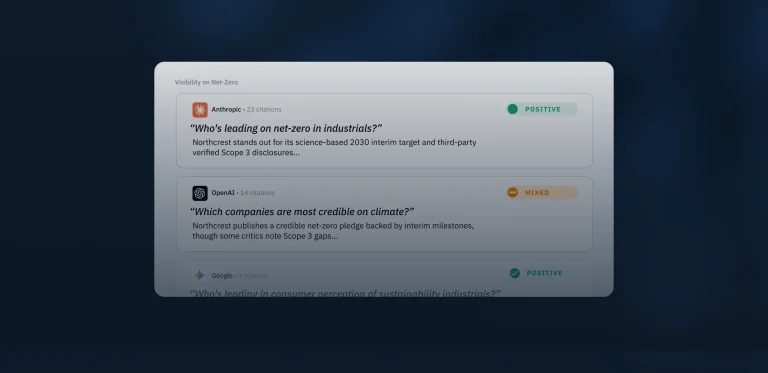
3BL has released an update to our content analytics that helps you understand how LLMs interact with your content across two dimensions.
Industry Insights
NOVEMBER 13, 2025

2025 Was a Big Year for Sustainability Communications. Here’s What the Research Said. 


3BL and TriplePundit’s data-backed reports traced the metrics, messages, and momentum driving corporate sustainability narratives.

From shifting consumer trust to the rise of individual impact, 2025 has been a turning point for sustainability communications. Through bold, data-driven research, 3BL explored how public sentiment, corporate action, and storytelling intersect to shape reputation and real-world outcomes. Across the four reports released this year, 3BL captured the pulse of the moment. Revealing why staying silent on sustainability is riskier than ever, how personal conviction is driving the next wave of change, and what it takes for brands to earn genuine trust in a skeptical world.

The Big Thing Americans Agree On 
The study, conducted in January 2025, sheds light on shifting consumer expectations and the growing role of sustainability in shaping purchasing decisions and brand loyalty. 

  • 73% of Americans believe their purchasing decisions can influence corporate behavior on social and environmental issues. 
  • While 65% of Gen Z and 64% of millennials lead in prioritizing sustainability, the study found that only 5% of Gen X and Baby Boomers consider sustainability completely unimportant.

Download here.

2025 is the Year of the Individual 
There is a striking trend shaping the sustainability and social impact landscape in 2025: the growing role of individual action.

  • Political and Generational Shifts: Republicans (22%) favor business-led impact, while Democrats (25%) lean on government. Gen Z trusts institutions, while Baby Boomers (38%) believe in individual action but show skepticism (26%).
  • Business Priorities: Consumers expect action on employee well-being (56%), sustainable packaging (54%), and ecosystem restoration (49%).

Download here. 

Say Less, Risk More: Sustainability Silence Is Undermining Trust
This report draws on media analysis and original polling to expose a growing crisis of confidence in corporate sustainability claims. The findings signal a clear warning: greenhushing may feel safe, but it’s undermining public trust and putting market share on the line.

  • A Decline in Corporate Voice: Media mentions of top U.S. companies tied to sustainability topics dropped nearly 10% in the first four months of 2025 compared to the same period last year.
  • Trust Is Slipping: Nearly a quarter (23%) of consumers now say they “rarely” or “almost never” trust what companies say about their sustainability goals, up from just 15% in December 2023. 

Download here. 

Sustainable Companies Make More Money, But Does Anyone Trust Them?  T
his research shows that companies recognized among the 100 Best Corporate Citizens aren’t just doing good, they’re performing better in the market too. From January 2022 to July 2025, these companies’ annual returns were 2.2% higher than the S&P 500. Even more impressive, repeat honorees generated a cumulative return of 106%, compared to just 37% for the S&P 500. Excluding outliers, the portfolio still delivered 40% cumulative returns versus the S&P’s 36.6%
Download here. 

Talk to our team

Teamwork and human resources, technology concept, human resources management in company business with network of people to support partnership, trust
Leadership Perspectives
NOVEMBER 7, 2025

AI is Building a New Trust Economy: Will PR Be Part of It?

The next battle in communications won’t be for reach. It’ll be for something far more valuable: credibility. Because AI isn’t just changing how we write. It’s deciding who gets heard.

Charlie Wilkie
Charlie Wilkie Chief Executive Officer

The pattern we should’ve seen coming

OpenAI is building an ad platform for ChatGPT. Google’s sliding “sponsored” links into AI search results. Microsoft beat them to it with Bing Chat.
Sound familiar? It should. It’s the same playbook search ran 20 years ago: free access first, monetization later.

Every major platform eventually sells what it organizes. Search organized information and sold attention. Social media organized connections and sold influence. AI organizes trust, not by judging it, but by scaling what the web has already learned to trust. This time, the product isn’t attention — it’s credibility.

The new gatekeepers

Here’s what most people miss: Language models don’t use just any source to create responses. They digest what exists — and, crucially, what they’ve learned to trust.

Early audits show something uncomfortable: AI assistants lean heavily on established outlets — CNN, BBC, The New York Times. The top ten capture nearly 80 percent of citations. Everyone else fights for scraps.
But there’s a bigger problem — those credible platforms are vanishing.

The trust vacuum

Journalism is bleeding while AI feeds. Google’s AI summaries alone could cut publisher traffic by 25 percent — $2 billion in lost revenue.

In the U.S., ad spend on news has fallen by nearly a third since before the pandemic and is four times less than it was in 2013. More than 60 percent of marketers still avoid “hard-news” placements altogether, treating real-world reporting as brand-unsafe. Keyword blocking of terms like war, politics, and climate costs U.S. publishers another estimated $2.8 billion a year, according to the University of Baltimore.

Yet there’s a flicker of reversal. Data from DoubleVerify shows ads on news sites drive nearly 10 percent higher engagement than non-news content. Some agencies say clients are reentering news-driven channels — even Fox and CNN — because audiences still trust those environments more than the social media feeds that replaced them.

After years of retreat, brands are rediscovering a basic truth: Reliable context is the real brand-safety filter. Avoiding the news may protect optics in the short term, but it erodes the very ecosystem that makes credibility possible.

Over 10,000 journalism jobs have vanished in the past 3 years. The Los Angeles Times, NBC News, CBS News — gutted. Fewer reporters mean fewer facts checked, fewer sources verified, and fewer reasons for audiences — or algorithms — to trust what they read.

The awkward saviors

Corporate funding now reaches roughly half of U.S. newsrooms — a survival tactic that demands clearer guardrails to protect independence.

The experiments are everywhere — and each carries tension. Tech giants fund fact-checking initiatives while being fact-checked themselves. As ad dollars retreat, surviving outlets turn to the same brands whose marketing budgets once sustained them.

Done wrong, it looks like manipulation. Done right, it’s something else entirely — business investing in the infrastructure of truth.

But what does “right” actually mean? We’re defining those rules in real time, with AI systems watching and learning from every decision. Transparency is the difference between earning trust and buying silence.

When business became the adult in the room

Here’s a number that should make journalists pause: the 2025 Edelman Trust Barometer finds business remains the most trusted institution globally at 62 percent — ahead of NGOs (58 percent), government (52 percent), and media (52 percent).

When the public trusts CEOs more than journalists, it’s flattering and terrifying in equal measure. Because when business becomes the most trusted voice, communications stop being marketing. They become part of the information infrastructure society relies on.

How to lead in the age of AI trust

Forget gaming the system. Here’s what actually builds credibility with people — and with the machines now mediating them.

Radical clarity. Publish facts, not spin. Make claims others can verify. Companies that admit challenges alongside successes build authority that lasts.

Consistent verification. Share information where scrutiny still exists: peer-reviewed research, regulatory filings, and credible newsrooms with editorial standards. AI systems are already learning to weigh these sources differently from corporate blogs.

Invest in the ecosystem. Support legitimate outlets through advertising or partnerships, but do it transparently and protect editorial independence.

The tools already exist

None of this is new. Commercial newswires have been part of the trust infrastructure since the 1950s, when PR Newswire and Business Wire became how markets moved. Stock exchanges trusted them. Analysts quoted them. Their structured releases fed the databases that became search algorithms.

At 3BL, we inherited that architecture. Sustainability data now travels the same pathways as financial disclosures carved decades ago. What markets once ignored as “non-material” now drives investment, regulation, and reputation.

The lesson: Trust compounds. Decades of structured, verifiable information built the credibility that AI systems now index — and amplify. Or erase, if we drown it in noise.

The choice

Here’s what could be coming: AI platforms are already experimenting with credibility tiers — ‘verified sources,’ ‘reliable domains,’ whatever they’ll call them. Information from outlets with consistent editorial or third-party verification will rise. Everything else will sink.

That doesn’t mean companies should publish less. It means they should publish differently.

If your releases, reports, or updates can be traced through citations, filings, or credible coverage back to independent verification, AI will treat them as a signal. If they only point back to you—repeated, reworded, or syndicated across your own channels—the systems will learn to classify them as noise. You’re not punished for communicating. You’re punished for circular sourcing.

Every communications budget now does one of two things: It funds trust or floods the pool.

The smart brands are already keeping the water clear — quietly, consistently, before anyone starts charging admission.

And the irony? AI might finally force PR to rediscover its purpose: proving what’s real. Not spinning it. Not amplifying it. Proving it.

Is your content signal or noise? The age of AI trust is already here. 3BL helps communications leaders make your information traceable, citable, and credible — before the algorithms start deciding for you. [Learn how trusted distribution works →]

Talk to our team